
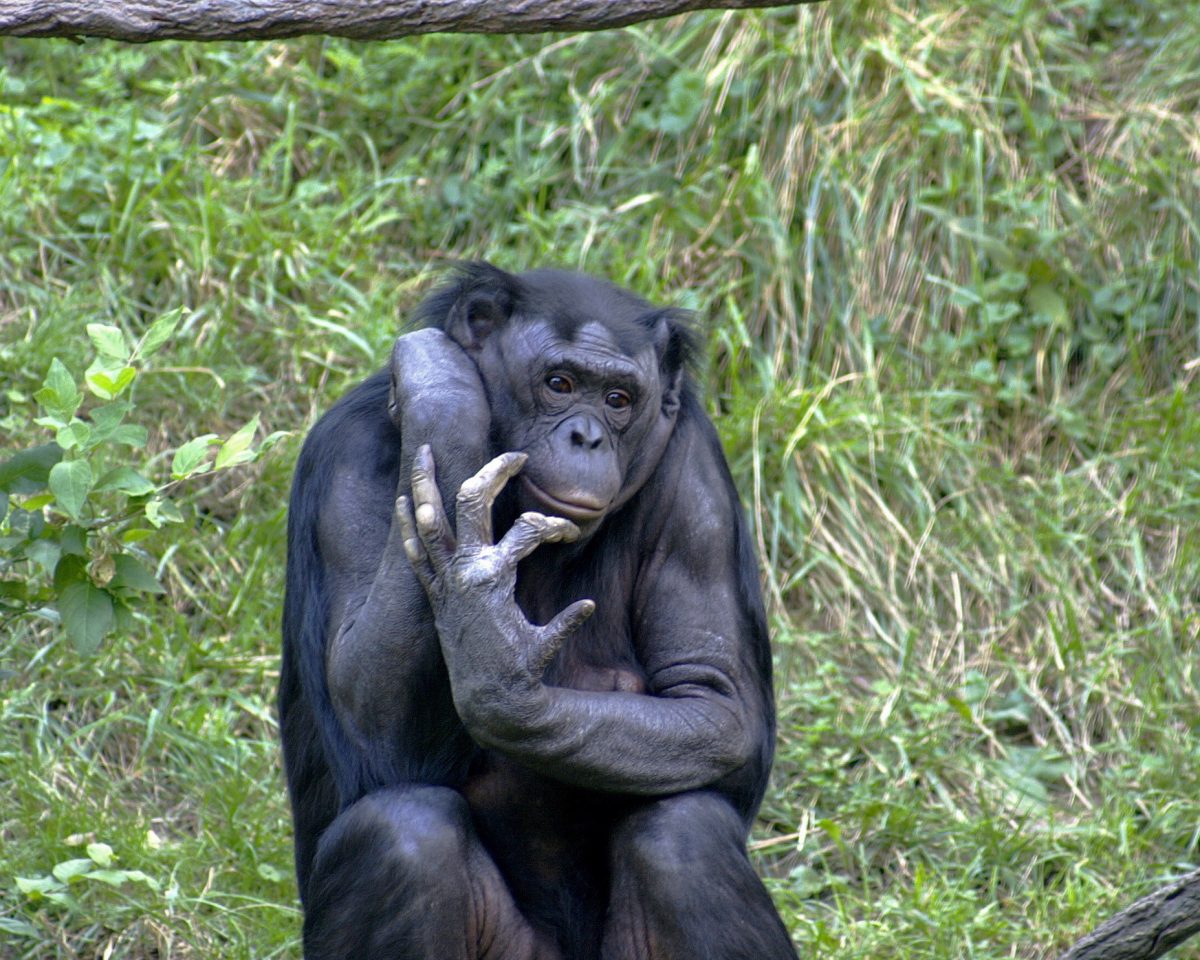
A new study proposes that make-believe play is a skill not only possessed by children, but also bonobos, an endangered great ape species who have been observed to have this same skill. This study was conducted by two researchers at Johns Hopkins University located in Baltimore, Maryland. The evidence within this research comes from Kanzi, a bonobo who was involved in this experiment and taking part in three pretended tea party-style experiments.
During earlier research, a young chimpanzee who was captive had been seen on two occasions between 2003 to 2004. The chimpanzee was dragging imaginary blocks along the floor, based on comparisons to his positioning when playing with real wooden blocks. On the other hand, female chimpanzees that were observed in the wild by researchers for over 14 years were seen to be carrying and playing with sticks as if they were dolls. This further questioned the possibility that animals could have the skills of make-believe play, similar to a human child.
Although, researchers have said that “the anecdotal nature of the evidence has left room for doubt.” It could be possible that the animals were mimicking behavior that they had noticed from humans. In order to provide stronger pieces of evidence, in 2024, researchers carried out controlled tests by using juice and grapes. This would involve Kanzi, a year before his death. In this experiment, Kanzi was presented with two squirt bottles, where one has juice and the other is empty. He was asked to pick the bottle that had juice, from the 18 trials Kazni had chosen the correct bottle every time. Then, in the final experiment it had a similar setup as the first part, but a grape was used instead. Kanzi had to identify which jar had the grape, resulting in him successfully identifying the correct jar around 68.9% of the time.
Researchers had concluded that “their findings suggest that the capacity for representing pretend objects is not uniquely human.” A primate behavioral ecologist, Nicholas E. Newtown Fisher, told CNN on Friday that “[t]hroughout his life, Kanzi repeatedly demonstrates skills that required us to reevaluate our understanding of ape-cognition.” He added, “It seems suitable, therefore, that he has also provided experimental evidence of imagination. This is an exciting finding that lends experimental support to anecdotal reports from both captive and wild-living individuals.”
On Friday, Bastos, a lecturer in the University of St. Andrews in Scotland, told CNN, “Kanzi was a particularly good subject for the study because he was language trained and one of very, very few apes who understood verbal prompts, which he responded to using a lexigram of over 300 symbols.”
Researchers said, “Due to these abilities, and since Kanzi was the only bonobo tested in the study, it is not clear whether the results can be applied to other apes.” Newton Fisher said, “As author of this research note, generalising from Kanzi to other bonobos, and to other ape species will require further investigation,” adding “However, while it is appropriate that we proceed with a degree of scepticism, I suspect that we systematically under-appreciate the cognitive abilities of these species.”