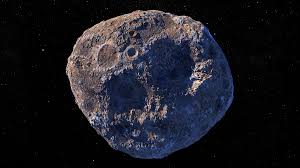
On May 10th, 2026, a new Apollo-class asteroid that is going to come close to Earth was discovered. This asteroid was named “2026JH2,” and it is currently racing towards Earth at about 20,000 miles per hour. 2026JH2 is expected to pass Earth on Monday, May 18th, 2026, and come even closer to Earth than the moon. This asteroid was discovered by an astronomical observatory, Mount Lemmon Observatory, that is positioned on Mount Lemmon in the Santa Catalina Mountains near Tuscan, Arizona.
It is estimated that 2026JH2 circles the sun every 3.7 million years, which explains why scientists have not previously identified this asteroid. The asteroid is assumed to be around 115 feet across, which is just above the maximum size of the largest animal ever known to have lived on Earth: the blue whale. Scientists can estimate the size of the asteroid based on multiple factors: the first is how bright the asteroid appears to the scientists, and the second is how much light the scientists believe the asteroid’s surface reflects.
Upon studying the asteroid, they concluded that the asteroid was about the size of two school buses. 2026JH2 is expected to pass within 56,000 miles of Earth, which makes it an Apollo-class asteroid. An Apollo-class asteroid is a type of Near-Earth Asteroid, also known as NEA, whose trajectory is going to cross Earth’s path and come relatively close to the planet. Believe it or not, a lot of Apollo-class asteroids are constantly being identified and studied, but they are usually too small and too far from Earth to be seen by people.
Calculations show that the asteroid’s trajectory poses no impact risk with Earth, despite the late discovery of the asteroid and how little time the scientists had to study the asteroid before it got close to Earth. The Virtual Telescope Project is planning to livestream the asteroid at 5:45 PM Eastern Time as it passes Earth on Monday, May 18th.
2026JH2 is an interesting asteroid because it is going to pass extremely close to Earth. To put it into perspective, the moon is about 238,000 miles from Earth, but 2026JH2 is going to be about 56,000 miles from Earth when it passes by. This means that the asteroid is going to pass by Earth more than four times closer than the moon. Additionally, 2026JH2 is special because it will be passing Earth nearly as close as an object of its size physically can without making an impact with Earth, and not many asteroids of this size have passed this close. On top of that, the asteroid is expected to reach peak brightness on May 18th, so the passing may be able to be seen by amateur astronomers and anyone who can use a small telescope to view the asteroid’s passing.