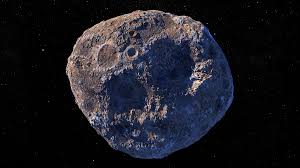
On May 18th, an asteroid had flown past Earth safely with no risk of impact. According to the European Space Agency, “An asteroid roughly the size of one to two school buses will fly by Earth Monday, coming as close as 91,593 kilometers.” However, this asteroid was expected by scientists because it was discovered previously on May 10th. The discovery was made by astronomers at Mount Lemmon Survey, a major astronomical project that committed to tracking and discovering NEO, also known as near-Earth objects, including asteroids.
This asteroid is named 2026JH2 and placed in the category of asteroids known as Apollo, which orbit the Sun on trajectories that will intersect with the Earth’s own to orbit around the Sun. Richard Binzel, a professor of planetary sciences at Massachusetts Institute of technology, said, “The asteroid originated from the asteroid belt, an area between Mars and Jupiter. Occasional collisions in the asteroid belt, plus gravitational tugs by Jupiter, can send small asteroids by Earth’s vicinity. This fact has been known for many decades and many thousands of asteroids that can pass the Earth are already known.”
According to Patrick Michael, the director of research and an astrophysicist at National Centre for Scientific Research in France, stated, “Even though astronomers have directly observed the object hurtling toward Earth, its exact size is unknown.” Although its size remains unknown, it has been predicted to be around 50 to 115ft. Patrick also said, “The uncertainty is due to the fact that when an optical telescope sees a new object, the only information it gathers is the object’s luminosity in visible light.” Based on the assumptions on how much light is being reflected, it is estimated to be about 15 to 30 meters, within a diameter.
2026JH2 was predicted to be about 24% of the average distance between the Moon and Earth, while being about two-and-a-half times more than the distance at hundreds of geosynchronous satellites orbit, which helps to provide telecommunications and weather forecasts. According to NASA’s JPL Small-Body Database, it stated, “The close pass is expected to occur on Monday just before 6 p.m. ET.”
The European Space Agency and NASA had confirmed that there was no risk of the asteroid. Additionally, in an email written by Richard Binzel, he had written, “Despite the proximity, the space rocket poses no danger. 2026JH2 will pass safely by Earth. This is actually a natural occurrence, car-sized objects pass between the Earth and Moon every week. At the size of a school bus, these pass through our neighborhood several times per year.”